
Uncertainty has become a defining characteristic of modern business. Economic conditions can shift rapidly, technology evolves at an unprecedented pace, and unexpected global events can disrupt industries overnight. While uncertainty cannot be eliminated, organizations can control how they prepare for it.
Effective risk control is not about avoiding every potential threat. Instead, it focuses on understanding risks, reducing vulnerabilities, strengthening resilience, and ensuring that businesses can continue operating even when unexpected challenges arise.
Companies that manage risk effectively are often able to recover faster from disruptions, maintain stakeholder confidence, and capitalize on opportunities that less-prepared competitors may miss.
Why Risk Control Matters More Than Ever
Businesses today face a wider range of risks than previous generations encountered. Traditional concerns such as financial losses and operational failures remain important, but modern organizations must also address cybersecurity threats, reputational risks, regulatory compliance challenges, environmental events, and geopolitical uncertainty.
According to various industry studies, cybercrime costs alone are projected to reach trillions of dollars globally over the coming years. At the same time, supply chain disruptions experienced throughout the past decade have demonstrated how interconnected business operations have become.
For many organizations, the question is no longer whether disruptions will occur but when they will occur.
This reality has transformed risk control from a defensive activity into a strategic priority.
What Is Risk Control?
Risk control refers to the processes and actions organizations use to identify, evaluate, reduce, and manage potential threats that could negatively affect objectives.
The goal is not to eliminate all risk. Every business decision involves some level of uncertainty. Instead, risk control seeks to ensure that risks remain within acceptable levels.
Effective risk control generally involves:
- Identifying potential risks
- Evaluating likelihood and impact
- Implementing preventive measures
- Monitoring changing conditions
- Developing response plans
- Continuously improving controls
Organizations that follow this cycle consistently tend to develop stronger operational resilience over time.
The Difference Between Risk Avoidance and Risk Control
One of the most common misconceptions is that effective risk management means avoiding risk entirely.
In reality, growth often requires calculated risk-taking.
For example, a company entering a new market faces uncertainty regarding customer demand, competition, and regulatory requirements. Avoiding expansion eliminates those risks but may also eliminate significant growth opportunities.
Effective risk control allows organizations to pursue opportunities while reducing exposure to preventable losses.
Instead of asking, “How do we eliminate risk?” successful leaders often ask, “How do we understand and manage this risk responsibly?”
That distinction can significantly influence long-term performance.
The Core Components of Effective Risk Control
While every organization has unique needs, strong risk control frameworks often share several key characteristics.
Risk Identification
The first step is understanding what could go wrong.
Organizations frequently conduct risk assessments to identify vulnerabilities across:
- Financial operations
- Technology systems
- Supply chains
- Regulatory compliance
- Human resources
- Physical assets
- Strategic initiatives
Many companies use workshops, audits, interviews, historical data analysis, and scenario planning to uncover potential risks.
The most effective organizations view risk identification as an ongoing process rather than an annual exercise.
Risk Assessment
Once risks are identified, leaders must determine their significance.
Assessment typically considers:
- Probability of occurrence
- Potential financial impact
- Operational consequences
- Reputational effects
- Regulatory implications
For example, a temporary website outage may have limited impact for one business but create substantial revenue losses for an online retailer.
Context matters.
The same risk may require different responses depending on organizational priorities and exposure levels.
Risk Mitigation
Mitigation involves reducing either the likelihood of a risk occurring or its potential consequences.
Examples include:
- Installing cybersecurity protections
- Diversifying suppliers
- Strengthening quality controls
- Implementing employee training programs
- Purchasing insurance coverage
- Establishing backup systems
The most effective mitigation efforts focus on practical measures that deliver measurable reductions in risk exposure.
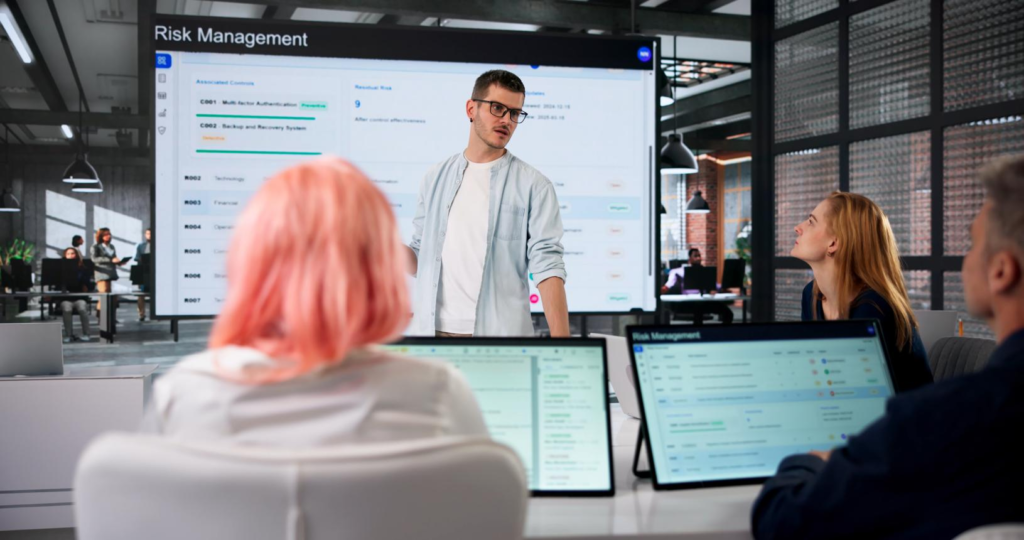
Monitoring and Review
Risk environments change constantly.
Controls that worked effectively two years ago may be insufficient today.
Organizations therefore need continuous monitoring systems that track:
- Emerging threats
- Regulatory developments
- Industry changes
- Technology trends
- Internal performance indicators
Regular reviews help ensure that controls remain aligned with current realities.
How Technology Is Reshaping Risk Control
Technology has become both a source of risk and a critical tool for managing it.
Organizations increasingly rely on advanced systems to improve risk visibility and response capabilities.
Modern risk control technologies may include:
- Real-time monitoring platforms
- Artificial intelligence risk analytics
- Predictive modeling tools
- Cybersecurity detection systems
- Automated compliance monitoring
- Business continuity software
For example, financial institutions often use machine learning algorithms to detect unusual transaction patterns that may indicate fraud.
Similarly, manufacturers use predictive maintenance systems to identify equipment issues before failures occur.
Technology allows organizations to move from reactive responses toward proactive risk management.
Cybersecurity: A Critical Risk Control Priority
No discussion of modern risk control is complete without addressing cybersecurity.
Virtually every organization depends on digital systems, making cyber risk a major concern regardless of industry.
Common cyber threats include:
- Ransomware attacks
- Data breaches
- Phishing campaigns
- Insider threats
- System vulnerabilities
- Third-party vendor compromises
Effective cybersecurity risk control typically combines technology, policies, and employee education.
Organizations often implement:
- Multi-factor authentication
- Endpoint protection
- Network monitoring
- Security awareness training
- Incident response planning
- Regular vulnerability testing
Businesses that treat cybersecurity solely as an IT issue frequently underestimate its broader operational and financial implications.
The Role of Leadership in Risk Control
Risk control is most effective when leadership actively supports it.
When executives prioritize risk awareness, employees are more likely to recognize and report potential issues.
Strong leadership involvement often includes:
- Establishing clear accountability
- Promoting transparent communication
- Supporting risk reporting
- Allocating adequate resources
- Encouraging informed decision-making
Organizations with healthy risk cultures generally view risk discussions as opportunities for improvement rather than exercises in assigning blame.
This cultural approach often improves both problem identification and organizational resilience.

Building Risk Control Into Daily Operations
Many organizations struggle because risk management exists separately from day-to-day operations.
Effective risk control becomes far more valuable when integrated into routine decision-making.
Examples include:
- Evaluating vendor risks before contracts are signed
- Reviewing cybersecurity implications before software deployment
- Assessing compliance requirements during product development
- Considering operational impacts during strategic planning
Embedding risk considerations into normal workflows helps organizations identify issues earlier and respond more effectively.
Over time, risk awareness becomes part of organizational behavior rather than an isolated compliance activity.
Lessons From Real-World Disruptions
Recent years have provided numerous examples of why risk control matters.
Supply chain disruptions highlighted the dangers of relying too heavily on single suppliers or geographic regions.
Cyberattacks demonstrated how quickly operational interruptions can affect revenue, reputation, and customer trust.
Natural disasters showed the importance of business continuity planning and recovery capabilities.
Organizations that navigated these challenges successfully often shared several characteristics:
- Strong contingency planning
- Diversified operational structures
- Reliable communication systems
- Well-documented response procedures
- Regular testing and preparedness exercises
Preparation frequently determines whether disruptions become temporary setbacks or long-term crises.
How Small and Mid-Sized Businesses Can Strengthen Risk Control
Risk control is not only for large enterprises.
Small and mid-sized businesses can implement highly effective risk management practices without massive budgets.
Practical steps include:
- Conducting quarterly risk reviews
- Maintaining emergency response plans
- Training employees regularly
- Backing up critical data
- Reviewing vendor dependencies
- Purchasing appropriate insurance
- Monitoring regulatory developments
Even modest improvements can significantly enhance organizational resilience.
In many cases, awareness and preparation provide greater value than expensive technology investments.
What Does a Mature Risk Control Program Look Like?
Organizations with mature risk control programs generally exhibit several common characteristics.
They:
- Identify risks proactively rather than reactively
- Use data to support decision-making
- Continuously monitor changing conditions
- Test response plans regularly
- Encourage open communication
- Integrate risk considerations into strategy
- Invest in employee education
- Review and improve controls continuously
Most importantly, mature organizations recognize that risk control is an ongoing journey rather than a one-time project.
As business environments evolve, risk management practices must evolve as well.

Frequently Asked Questions
1. What is the primary purpose of risk control?
The primary purpose is to reduce the likelihood and impact of events that could prevent an organization from achieving its objectives.
2. Can all business risks be eliminated?
No. Every business faces uncertainty. Risk control focuses on managing risks within acceptable limits rather than eliminating them entirely.
3. Why is risk control important during economic uncertainty?
Periods of uncertainty often increase volatility, making preparation, monitoring, and response planning more important for maintaining stability.
4. What industries need risk control the most?
All industries benefit from risk control, including healthcare, finance, manufacturing, technology, retail, education, and government organizations.
5. How often should risk assessments be conducted?
Many organizations perform formal assessments annually or quarterly, while continuously monitoring emerging risks throughout the year.
6. What role does cybersecurity play in risk control?
Cybersecurity protects critical systems, data, operations, and customer information from increasingly sophisticated digital threats.
7. Is risk control only for large corporations?
No. Small businesses often benefit significantly from structured risk control because they may have fewer resources available to absorb disruptions.
8. What is business continuity planning?
Business continuity planning involves preparing procedures that allow critical operations to continue during disruptions or emergencies.
9. How can organizations create a stronger risk culture?
Leadership support, employee training, transparency, accountability, and open communication all contribute to stronger risk cultures.
10. What is the biggest mistake organizations make regarding risk?
Many organizations focus only on known risks while failing to monitor emerging threats and changing business conditions.