Diversified income streams are transforming financial planning in the U.S., shifting the focus from budgeting alone to actively managing multiple sources of earnings. This article explains how Americans are integrating side income, investments, and scalable earnings into long-term strategies, improving resilience and flexibility while redefining what financial stability looks like in today’s economy.
A Structural Change in Financial Planning
Financial planning in the United States has traditionally centered on a predictable model: earn a steady salary, save consistently, and invest for long-term goals like retirement. While this model still applies, it is no longer sufficient for many households navigating today’s economic landscape.
The emergence of diversified income streams has introduced a new dimension to financial planning—income is no longer treated as fixed. Instead, it is viewed as something that can be expanded, adjusted, and optimized over time.
According to data from the Federal Reserve and the U.S. Bureau of Labor Statistics, a growing share of Americans report earning income from multiple sources. This trend reflects not only changing economic conditions but also a shift in how individuals approach financial security.
Why Diversified Income Is Becoming Central to Planning
Several forces are driving the integration of multiple income streams into financial planning strategies.
Rising living costs continue to outpace wage growth in many regions. Households are seeking additional income to maintain purchasing power and meet long-term goals.
Income uncertainty has become more common. Layoffs, contract work, and industry changes have made single-income reliance riskier.
Access to digital tools has expanded opportunities. Platforms for freelancing, investing, and content creation make it easier to generate income outside traditional employment.
Changing financial priorities are also at play. Americans are increasingly focused on flexibility, early retirement options, and reducing reliance on a single employer.
Together, these factors have elevated income diversification from a supplementary tactic to a core planning principle.
From Static Budgets to Dynamic Income Models
One of the most significant changes in financial planning is the shift from static budgeting to dynamic income modeling.
Traditionally, households created budgets based on a fixed monthly income. Today, many are working with variable income streams that fluctuate over time.
This requires a different approach:
- Building flexible budgets that account for income variability
- Prioritizing essential expenses while managing irregular earnings
- Creating buffer savings to stabilize cash flow
- Tracking multiple income sources separately
Financial planners increasingly recommend treating income like an investment portfolio—diversified, monitored, and adjusted as needed.
Types of Income Streams in Modern Financial Plans
Modern financial planning incorporates a range of income sources, each serving a different purpose.
- Primary earned income: Provides stability and covers core expenses
- Supplemental active income: Freelance work or consulting for additional cash flow
- Investment income: Dividends, interest, and capital gains for long-term growth
- Asset-based income: Rental properties or royalties
- Scalable digital income: Online products, courses, or subscription services
The goal is not to maximize the number of streams, but to create a balanced mix that supports both short-term needs and long-term objectives.
Real-World Financial Planning in Action
To understand how diversified income reshapes planning, consider these examples:
Example 1: The Dual-Income Family
A couple earning $130,000 combined income supplements their earnings with rental property income and part-time consulting. Their financial plan includes reinvesting rental profits into additional properties while using consulting income for discretionary spending and savings.
Example 2: The Mid-Career Professional
A 38-year-old finance manager builds a second income stream through freelance advisory work. Over time, this income becomes consistent enough to support accelerated retirement contributions.
Example 3: The Entrepreneurial Employee
A software engineer maintains a full-time job while developing a subscription-based app. As the app generates recurring revenue, it becomes a key component of his long-term financial strategy.
These examples highlight how diversified income is integrated into broader financial goals rather than treated as separate or temporary.
Risk Management Through Income Diversification
One of the most important benefits of diversified income is improved risk management.
Relying on a single income source exposes households to significant risk. Job loss or income disruption can have immediate financial consequences.
Multiple income streams help mitigate this risk by:
- Providing alternative sources of cash flow
- Reducing dependence on a single employer
- Allowing quicker recovery from financial setbacks
This approach aligns with principles used in investment management, where diversification is a key strategy for reducing risk.
The Role of Passive and Semi-Passive Income
Passive income plays an important role in modern financial planning, but expectations have become more realistic.
Common forms include:
- Dividend-paying stocks
- Rental properties
- Digital products
- Automated business systems
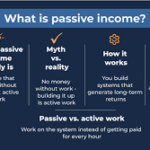
However, most passive income streams require upfront effort or capital. Many financial planners now use the term “semi-passive” to describe income that becomes less time-intensive over time but still requires oversight.
Incorporating these streams into a financial plan can provide long-term stability and reduce reliance on active work.
Tax Planning and Regulatory Considerations
Diversified income introduces additional complexity in tax and legal planning. In the U.S., different income types are subject to different tax treatments.
Key considerations include:
- Self-employment taxes for freelance income
- Capital gains taxes on investments
- Depreciation and deductions for rental properties
- Quarterly estimated tax payments
Proper recordkeeping and professional guidance are essential. Many households benefit from working with CPAs or financial advisors to optimize tax strategies and ensure compliance.
Technology’s Role in Managing Multiple Income Streams
Technology has become an essential tool in managing diversified income.
Popular solutions include:
- Accounting software for tracking income and expenses
- Budgeting apps that handle variable income
- Investment platforms for managing portfolios
- Automation tools for digital income streams
These tools reduce administrative burden and allow individuals to focus on strategy rather than manual processes.
Common Challenges and How to Address Them
While diversified income offers clear benefits, it also presents challenges.
Time management is often the biggest hurdle. Balancing multiple income streams requires discipline and prioritization.
Income variability can make financial planning more complex. Building an emergency fund can help stabilize cash flow.
Overextension is another risk. Taking on too many income streams at once can reduce effectiveness and increase stress.
A practical approach is to start with one additional income stream and expand gradually, ensuring each is sustainable before adding another.
Frequently Asked Questions
1. What are diversified income streams?
They are multiple sources of income, such as salary, freelance work, investments, and business earnings.
2. Why are diversified income streams important in financial planning?
They improve financial resilience and reduce reliance on a single income source.
3. How many income streams should I have?
There’s no fixed number, but starting with one additional stream is a common approach.
4. Are diversified income streams necessary for everyone?
Not required, but increasingly beneficial given economic uncertainty.
5. How do I manage taxes for multiple income sources?
By keeping detailed records and consulting a tax professional when needed.
6. What is the difference between active and passive income?
Active income requires ongoing work, while passive income requires less ongoing effort after setup.
7. Can diversified income replace a full-time job?
In some cases, yes—but it typically requires time to build reliable streams.
8. What are the risks of multiple income streams?
Time constraints, income variability, and increased financial complexity.
9. What tools help manage diversified income?
Accounting software, budgeting apps, and investment platforms.
10. How long does it take to build diversified income?
It varies, but most people see meaningful progress over several months to a few years.
The Future of Financial Planning in the U.S.
As diversified income becomes more common, financial planning is evolving to reflect this reality. Advisors are placing greater emphasis on income generation strategies alongside traditional saving and investing.
Employers and financial institutions are also adapting, offering tools and resources that support flexible earning models.
This shift represents a broader transformation in how financial security is defined—not as a fixed state, but as a dynamic system that evolves over time.
A More Adaptive Approach to Building Wealth
Diversified income streams are not just a response to economic pressure—they represent a more adaptive approach to building and sustaining wealth.
By combining multiple sources of income, Americans are creating financial systems that are more resilient, flexible, and aligned with their long-term goals.
This approach requires planning, discipline, and ongoing adjustment, but it offers a pathway to greater financial stability in an increasingly complex economy.
When Income Becomes a Planning Tool, Not Just an Outcome
The most significant change in modern finance is the recognition that income itself can be actively managed. Instead of treating income as a fixed input, households are using it as a strategic tool to achieve financial goals.
This shift is reshaping not only how Americans earn, but how they plan, invest, and prepare for the future.
Key Signals of the New Financial Planning Model
- Income is treated as flexible rather than fixed
- Multiple streams are integrated into long-term strategies
- Risk is managed through diversification
- Passive and semi-passive income are prioritized over time
- Financial planning includes both earning and investing strategies